Showing posts with label Olympics. Show all posts

Thursday, September 18, 2008

Go to China to see the future

I have been back in New York for a week. This is the first time that I don't feel excited to be back in this energetic city that I love. Usually, when I leave Beijing, I don't miss it much. Yet even though I haven't lived in Beijing for about 20 years, this time I really do miss it. I miss the excitement of the Olympics and Paralympics; I miss the Bird's Nest, the Water Cube, the National Theater; I miss the clean and wide streets; I miss the modern and smooth subways--all the things I don't see here in New York!

While I was searching for answers about my feelings for Beijing and New York, I read Thomas Friedman's Op-Ed "A Biblical Seven Years". Friedman put all those puzzles together and made such a powerful point when he said "... go to China to see the future." Then I read another blog "Beijing Diary", with the same message: "In many circles, China has moved beyond America and other countries, in looking forward to a future that combines the very best of East and West."

I would have never expected to feel about Beijing and New York the way I do now. For me, New York is a world class metropolitan city that hardly any other city in the world compares with. But now I am not so sure about this anymore. Look at Beijing's streets, subways, buildings - the city has transformed itself into a metropolitan city in a matter of years. Beijing has built six subway lines within seven years and two more lines will be completed by early next year. Contrast that to New York, whose negotiations for the second avenue subway line are still pending after more than ten years! Beijing's International Airport Terminal 3 - the world largest single building - welcomes travelers around world with its grand and contemporary architecture, but New York's La Guardia and JFK airports welcome travelers with "dumpy terminals" and bumpy roads. And it was only a few years ago, when Beijing's streets were dirty and dust was everywhere because of the ongoing construction. But now all streets (really literally all) are so clean and many narrow streets have been expanded to boulevards, some even decorated with beautiful flowers in between.

Of course, I know we cannot judge a city based on streets, architecture, or subway, there are many other important things that we should look at, such as the living standard, education, culture, housing, food, leisure, and more. However, I think Beijing has them all or are getting there at a rapid pace now. Beijing is not the same city as the one I grew up in, nor the one that I left about 20 years ago. It has became a modern metropolitan city that I can compare with even New York. Moreover, it has the grand ancient history and culture of the Forbidden City, the Great Wall, the Temple of Heaven, or the Peking Opera.

I know it remains to be seen if Beijing can live up to these new ideals and sustain the grandness, the cleanliness and efficiency now that the 2008 Beijing Olympic Games are over. I guess only time will tell.

Share/Save/Bookmark

Sunday, September 07, 2008

Beijing Olympics and Paralympics

The Beijing Olympics ended two weeks ago, but the Games are still the topic among the media and Beijing residents. We still can watch and read collections of the best performances, biographies or stories of Chinese athletes on TV and in the newspaper and magazines. Wherever you go, Beijing residents talk about the Olympics, what they've seen in person or on TV, which games and athletes they like most, and what they think the Bird's Nest and Water Cube should become after the Paralymics.

And the most talked-about is if Beijing should keep the traffic regulations enforced during the Olympics – drivers can drive only on the odd dates if their plates have odd numbers and vice-versa. People debate it on TV and radio, and send their text messages to all media considered. Of course, people without cars, which are the majority, prefer the regulation because it controls the unbearable traffic jams and keeps the air cleaner. People with cars have varying opinions: some are for the regulations, some are not. Some who disagree say they'd buy another car with a different plate number, so they can drive everyday. Then people worry this regulation would help keep many cars away from the streets if lots of people purchase two cars. People from all backgrounds try to voice their concerns and are curious to see if the Beijing government will make the final decision based on what most residents want. This decision will be made right before September 20th, the closing date of the Paralympics and the day the regulation was supposed to end.

The Paralympics started on Saturday, September 6th. Although the media shows everything about the Paralympics, it's business as usual on the streets and for people in Beijing, compared to the opening day of the Beijing Olympics. (That day, all offices were closed, all stores were closed at 3 p.m., and flights were grounded at noon.) When I told my friend I'd like to join her family to watch the opening ceremony, they even didn’t know that the Paralympics would open on Saturday. But when we watched them together, everyone was surprised, excited, and moved by the great performances. We all thought it was as great as the opening ceremony of the Beijing Olympics. When the Paralympic flame was lighted, people were so excited to see the flame burning again.

The next day all the media showed things surrounding the opening ceremony. Director Zhang Yimou discussed his ideas and visions for this ceremony. People talk about it at home and on the streets. When I went to the Bank of China, I saw crowds of people buying the tickets for different games, and all tickets for events at the Bird's Nest and Water Cube were sold out. Now Beijing has another 11 exciting days to celebrate the Paralympic sports and spirit, which will be just as exciting as the 16 days of the Beijing Olympics.

You can learn more about the Paralympics at the official Paralympics site.

Read more about the Opening Ceremony of Paralympics (ChinaSprout will sell the DVD of Opening Ceremony of Paralymic shortly).

And you can watch some games live on CCTV.com or Sohu.com


Share/Save/Bookmark

Monday, August 25, 2008

Goodnight Beijing - Olympics 2008

This is the final video segment of a joint project with the Asia Society and ChinaSprout. Click here to learn more about the Asia Society Channel on YouTube.

Beijingers party for the Olympics closing ceremonies...find out why getting gold was so important, their beef with Western media, and what the Olympics legacy will be for them.


Share/Save/Bookmark

Sunday, August 24, 2008

Beijing Olympics Closing Ceremony


Share/Save/Bookmark

China Youth Speak Out-Olympics 2008

This video segment is part of a joint project with the Asia Society and ChinaSprout. Click here to learn more about the Asia Society Channel on YouTube.

Beijing college students discuss internet freedom, Olympics pride, cultural differences with the West and how they're different from their parents. A frank dinner discussion with Chinese youth and Asia Society, recorded 8/20/08.


Share/Save/Bookmark

Saturday, August 23, 2008

Beijing Olympics and Beyond

As the Beijing Olympics wind down, Beijing and its people feel sad that the games are over, athletes are leaving, and the closing ceremony is tonight. TV moderators keep saying they wish the games would continue, and people on the streets wish they could see more live coverage of the games. Before I came to Beijing in July, friends told me everyone in Beijing couldn’t wait until the Beijing Olympics ended. Now the same friends tell me how much they enjoy the games and how they're impressed with everything from the Bird's Nest to the Water Cube to each game they have watched. They worry they'll never enjoy such a big festival in Beijing again!

I also met some American athletes at the U.S. House and chatted with them about their experiences in Beijing. Shaun Jordan, a member of the U.S. relay teams in the 1988 and 1992 USA Olympic Swim Teams, told me he's been to all the summer Olympics since 1988 except the Sydney 2000 games, and he thinks the Beijing Olympics are the most impressive. When I asked him why, he said, “Your people are the most friendly people I have ever met." I was almost in tears when I heard that and asked him why he thought so. He said that wherever he goes, people are so nice, helpful, and open to him. He even sat down with an old Chinese lady at a Siheyuan (traditional square yard in Beijing) and had tea and chatted with her. Shaun is also very impressed with the architecture in Beijing. He said he'd never seen a city with such ancient architecture like the Forbidden City and Temple of Heaven on one side and contemporary architecture like the Bird's Nest, Water Cube, and CCTV on the other side. He also appreciated the organization of the games, which created a smooth experience for athletes and spectators alike. Shaun loves Beijing so much that he extended his stay for two days.

Tiffany Scott, a figure skater who competed at the 2002 Winter Olympic Games, came to Beijing on a study program during the Olympics. She loved Beijing so much when she came to compete and always wanted to come back. She and her classmates have been in Beijing for about a month to learn about Chinese culture and Chinese sports, particularly women athletes. While studying at the university, they also attended various games and toured Beijing. Tiffany said she loves Chinese culture and has learned lots about it this time. She enjoyed all the sightseeing and great shopping in Beijing! I also met a few more athletes who told me how much they and their families enjoy Beijing. They all wish they could stay longer or come back soon!

I just read an article about the Beijing Olympics at the New York Times. While the author mentioned the same friendliness and good organization, there are (as expected) words criticizing the Chinese government and people. Maybe the author has not seen Chinese’ spontaneous celebrations, but it doesn’t mean that the government controls people's celebrating or that Chinese don’t want to celebrate. In the stadiums, you do see all Chinese cheering for athletes--not only Chinese athletes, to whom they do shout louder, but all athletes. They wave different national flags, and stand up when people wave just like in any American stadium. At the beach volleyball games, many Chinese sing and dance just like the spectators from Brazil! Chinese may not always shout as loud or celebrate as spontaneously as some foreign visitors, but this simply reflects the Chinese mentality. We are just not the kind of people who shout and celebrate spontaneously as Westerners do! Hope you can respect this just like we respect your manner of celebrating!

I don't know if you've read about Beijing's skies lately, but today Beijing has sunny blue skies since August 15th. The closing ceremony will be held on a beautiful day that will make the Bird's Nest even more beautiful and impressive. We are sad that we have to say goodbye to the Beijing Olympics and see the Olympic flame go down, but the Olympic spirit and Beijing Olympics will be in our memory forever.


Share/Save/Bookmark

Chinese Kindergarten-Olympics 2008

This video segment is part of a joint project with the Asia Society and ChinaSprout. Click here to learn more about the Asia Society Channel on YouTube.

An American 7 year-old visits a Beijing kindergarten - and finds out what kids in China think about the Olympics, learning English, and more..."the world is getting smaller and smaller." Asia Society visits "Chris International Kindergarten" 8/21/08


Share/Save/Bookmark

Thank you, China!


This is from today's cover page of the Beijing Youth Daily, a very popular newspaper in Beijing:


Share/Save/Bookmark

Wednesday, August 20, 2008

Beijing Rock - Asia Society at the Olympics

This video segment is part of a joint project with the Asia Society and ChinaSprout. Click here to learn more about the Asia Society Channel on YouTube. Click here to see ChinaSprout's contemporary music selection.

Beijing's hot bands - Xie Tianxiao's Cold-Blooded Animal, and Jiang Xin's Super Monkey. Join us for Day 2 of our week in the life of Beijing during the Olympics as pop culture and music industry maven Scarlett Li shows what's new and exciting in China's music scene.


Share/Save/Bookmark

Tuesday, August 19, 2008

An Olympics Visit to Google Greater China

This video segment is part of a joint project with the Asia Society and ChinaSprout. Click here to learn more about the Asia Society Channel on YouTube.

Mixing the best of East and West at Google Greater China...see what may be the best and most fun jobs to be had in China, and how the Google culture is being adapted, to Chinese tradition. Hear the secret of the Google philosophy from Kai-Fu Lee, VP Google Inc and President, Google Greater China - interviewed 8/18/08 for Asia Society's special series on A Week in the Life of Beijing During the Olympics.


Share/Save/Bookmark

Monday, August 18, 2008

Michael Phelps and The Other Side of The Story (Continued)

When I posted a blog entry in June titled The Other Side of The Story, I never expected to be posting a continuation of that message during the Beijing Olympics. At the time, I'd witnessed differing press coverage in China and the U.S. about the Sichuan earthquake, and I hoped my message could bring a different perspective for people who can't see the other side of the story.

Now, I'm seeing gaps between the two sides again. I thought Olympics coverage would focus only on sports and was surprised when the reports included politics and continual criticism of China's achievements. Right after the Opening Ceremony, I wanted to know what the New York Times wrote about it, and I was surprised to read all the between-the-lines criticism when it tried to say it was a spectacular performance. I started to write about it in my last blog entry on the Opening Ceremony, but then I thought maybe this would be the only article in such a mood. So I didn't mention it. But now, after reading this article about how Chinese think of Michael Phelps, I feel compelled to write about it.

The author says Chinese don’t know much about Phelps because he isn't like NBA stars or Chinese athletes such as Yao Ming or Liu Xiang. The author says few Chinese know about him because “there are empty seats in the Water Cube aquatics center for his races, state-run Chinese newspapers are providing muted coverage…” I'm surprised the author didn’t know those empty seats are all from multinational sponsors (maybe also Phelps’ sponsor) who hold onto tickets for their clients who don’t pay for the tickets and didn’t show up. The swimming tickets are the most in-demand tickets, even more than track and field. Chinese buy them online or in front of the gate for 5 to 10 times the original price. All Olympic tickets were completely sold out in China in July, after all rounds since April 2007. So if you see empty seats at any game, don’t be surprised. Those were tickets that sponsors or their clients didn’t use.

About the “state-run Chinese newspapers” coverage of Phelps, I don’t know which paper the author meant, maybe one I don’t read and few other Chinese read. I read the two most popular newspapers in Beijing, Beijing Youth Daily and Beijing Evening News. Since Phelps arrived in Beijing before the Opening Ceremony, those papers reported on his arrival at the airport, his first visit to the spectacular Water Cube, and his medals in Athens and beyond. Of course, once the competitions began, these papers reported on him with long articles and color photos. I learned lots about Phelps, everything from why his body is superior as a swimmer to how much he eats and sleeps, how his mother raised him, and what he does in the Olympic village. If “a concern about inflaming Chinese nationalism might be at work in the restrained coverage of Phelps” as said by Susan Brownell, a Fulbright scholar at Beijing Sport University, how could all these reports come from “state-run” newspapers. And you can see some of them here:

http://www.ynet.com/view.jsp?oid=42245666
http://www.ynet.com/view.jsp?oid=42245611
http://www.ynet.com/view.jsp?oid=42148185
http://www.ynet.com/view.jsp?oid=42165387
http://www.ynet.com/view.jsp?oid=42167984
http://www.ynet.com/view.jsp?oid=42168340
http://www.ynet.com/view.jsp?oid=42177967
http://www.ynet.com/view.jsp?oid=42168340

I hope you can now see the other side of the story. By the way, have you read any articles about Beijing’s sky, blue and sunny since last Friday?


Share/Save/Bookmark

Sunday, August 17, 2008

Watching the Beijing Olympics

It is about ten days after the Opening Ceremony; about half of the competitions have been completed and nearly 400 medals have been given to the greatest athletes. The Beijing Olympics is the only topic the media covers, and people talk it about all over Beijing. Lucky ones see the events in person, but people don’t complain when they can watch live coverage on TV at home, in the office, or on the street. There are five TV stations showing live coverage of different events simultaneously.

When I shopped at the antique market, I saw big screens in different areas in the market. Buyers and sellers watched the games while doing business. In another shopping district, hundreds of people watched live coverage on a gigantic screen. When I went to the bank, people were watching live TV coverage in front of the clerk's counter. Of course, people can also watch TV on subway platforms or on buses. People such as taxi drivers, who don’t have access to TV, listen to live coverage on the radio. They haven't missed any important games even though they can't watch live coverage on TV.

Hundreds of thousands of lucky people watched the Olympics in person, and I was one of them! Last year I tried to reserve tickets on the official Beijing Olympics website and the U.S. site. But after bidding on more than 20 games, I didn’t win anything. I thought I'd never get a chance to watch anything live. Luckily, one of my friend’s companies has some tickets as a sponsor, and the official U.S. site opened up to sell tickets again. Don’t ask me why those tickets suddenly became available. I went to see a volleyball game, a gymnastics competition, and a track and field event in the past few days. Wherever I go, I see hundreds of people in front of entrances selling and buying tickets; some tickets go from 80 rmb ($11) to 5,000 rmb ($724). I don’t know if anyone really paid that price, but I did see some people pay 1,800 rmb ($260) for a ticket that doesn’t have face value in the suite area (free ticket for the VIPs).

Inside the stadiums, the atmosphere was just unbelievable. Everyone was cheering (if not shouting), clapping, and waving, especially for the Chinese teams. Many spectators have China's flag tattooed on their faces and hold national flags, small or big. They were continually shouting “Zhong Guo Jia You” (China, go, go!). They were so loud I worried they'd disturb the athletes’ concentration, and I had a terrible headache the morning after a volleyball game. Of course, they had reason to shout, because it was China versus Cuba, the two best women's volleyball teams in the world. The last three rounds were so close that each team beat point by point, and even went to 32 to 30 (usually the game ends at 25) in the fourth round. Finally, China lost to Cuba, 15 to 13. I thought people would complain about China's team, but instead, they all said it was a good game and cheered for Cuba’s victory.

Watching the Beijing Olympics is definitely a life experience. Now I want to go to competitions I wasn't interested in before, because just being in that atmosphere is an absolutely worthy experience. For those of you who can't see the Olympics in person or watch live TV coverage, visit these websites. You'll see the live coverage on your computer:
http://2008.cctv.com/
http://2008.sohu.com/


Share/Save/Bookmark

Sunday, August 10, 2008

Behind the Scenes: Opening Ceremony

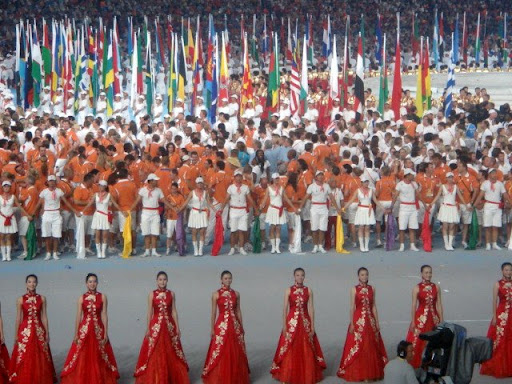
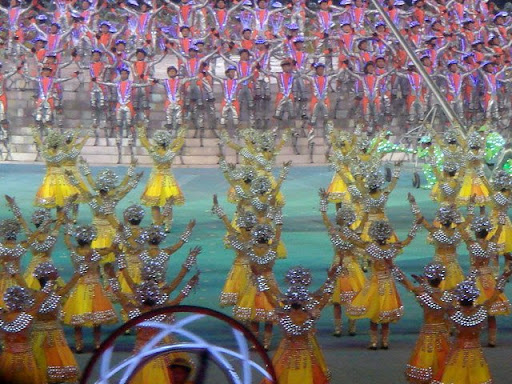
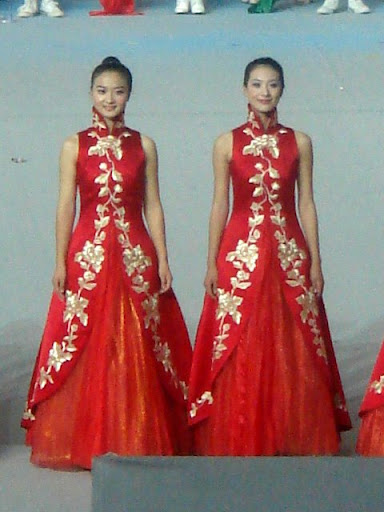
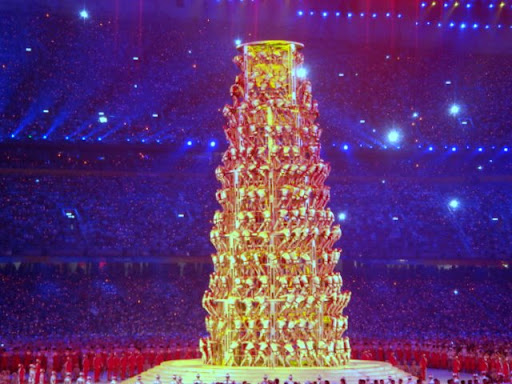
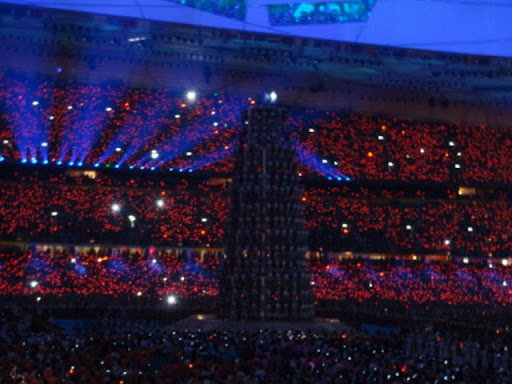
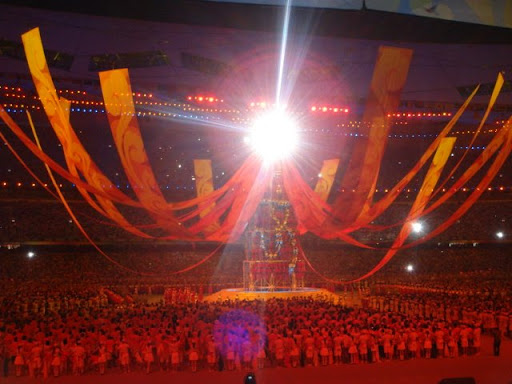
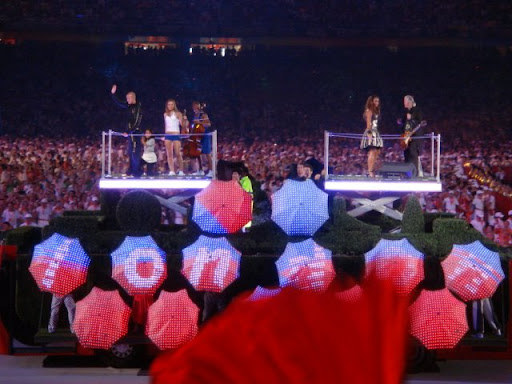
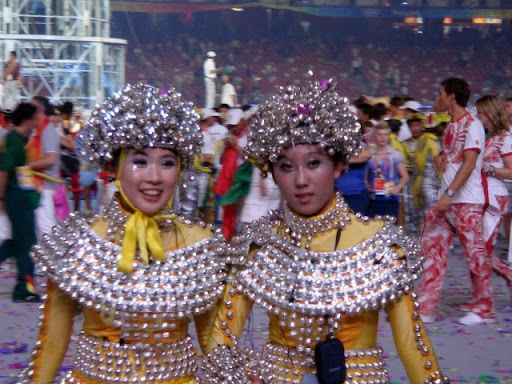
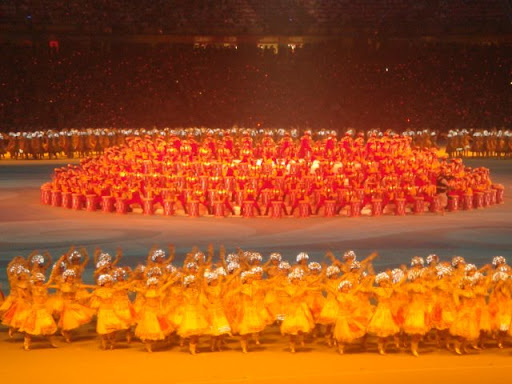
The day after the Olympics opening ceremony, everyone in China talked about the performances and behind-the-scenes activities: Who were those drummers? How could those character holders make characters and waves in such clean sequences? Is that really a Chinese painting scroll? How could performers dance on that huge ball? Who were those two sweet girls who sang the song and played piano with Lang Lang? Why was the Olympic flame lit that way? Endless questions, endless guesses. The media reported as much as they knew about all things behind-the-scenes.

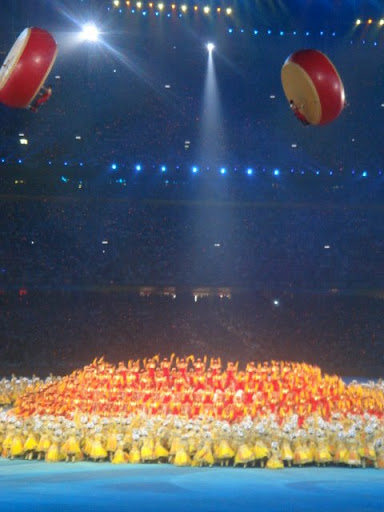
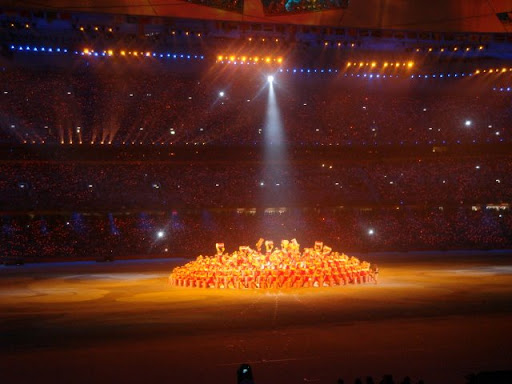
The 2,008 drummers and nearly 1,000 character performers are soldiers by profession, but ever since they were chosen by the directors of the ceremony nearly a year ago, they practiced daily in a secret place near Beijing, in the cold winter and hot summer. Since it's difficult to train all those performers at once, dozens of leaders were trained first, then those dozens trains hundreds, and the hundreds trained thousands. To make sure each performer knew his or her exact position during the performance, each one wore an earphone to listen to directions.

The big Chinese painting scroll is 147 meters long and 27 meters wide. It isn't a real scroll but a computer-controlled LED screen. But it has a special paper in the middle where dancers, opera performers, and children created the painting.

On the huge ball representing earth, there were 60 performers, along with 2,008 Tai-Chi performers from the same martial arts school near Shao Lin Temple in Henan province. They practiced for over a year. The people on bottom had the toughest challenge, because they had to perform upside down. Many had headaches and vomited during practice. The smiling faces of 2,008 children were collected around the world after the Beijing Olympic Committee asked for submissions of photos worldwide.

The girl who sang the song about the national flag (a song every Chinese knows) was a 9-year-old girl in Beijing who loves singing and dancing. The girl who played with Lang Lang was a 5-year-old Beijing kindergartener when she was selected to be interviewed this April. Director Zhang Yimou knew immediately she was the girl who would play with Lang Lang. But the Committee informed her only in June and she began practicing then. She and Lang Lang got a chance to practice together only in late July when Lang Lang came to Beijing.

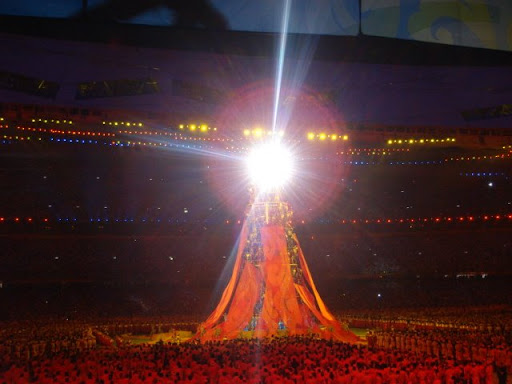
Director Zhang Yimou said in a press conference that the thing he worried about most during the performance was lighting the Olympic flame. He worried so much whether the running and lighting could be completed without an accident. It's very hard to run when when hung in that way. Li Ning secretly practiced over 6 months; he practiced only late at night in a secret location and didn’t tell anyone, even his relatives and close friends. Every time, the 2.59-minute run was so exhausting that he couldn’t do anything else afterwards. Why did he run around the Bird's Nest to light the flame? It comes from the Chinese saying of Tian Ren Yi He – Heaven and People are Harmony Together, so he ran to the heavens to light the flame! Now the 31-meter torch with an 8-meter fire is seen from a distance. The Olympic flame and spirit are showing the theme of this historic performance – He (Peace)!

UPDATE: ChinaSprout now carries the DVD of these jaw-dropping performances at the opening ceremony. This is a wonderful keepsake.


Share/Save/Bookmark

Saturday, August 09, 2008

China's Dream Comes True

Finally the Beijing 2008 Olympic Games began on 08.08.08! It was the day Chinese have been eagerly anticipating since 2001. The countdown went from years, months and days to hours and seconds. That day in Beijing, all offices were closed, stores closed at 3 p.m., and all flights were grounded since noon. Newspapers, radio, TV and all media were focused on the opening ceremonies, how an audience of 160,000 was prepared to attend, what the weather would look like that evening, and who would be the person to light the Olympic flames. Everyone was so excited to be celebrating what was essentially the biggest festival in history.

I went to my father's home near the Bird's Nest to watch the ceremony around 6 p.m. (Even I couldn't see the live performance.) On the way, I realized the city streets were empty. The taxi driver said even Chinese New Year's Eve was busier. He told me over and over how lucky I was to see the fireworks near the Bird's Nest. We could miss the Chinese New Year Eve’s performance, he said, because we would see it next year. But we can't miss the Olympics opening ceremonies, because this wouldn't happen again in 100 years. This is our dream of 100 years, and we should not let it slip by!

While I was surprised the taxi could take me right in front of the building as usual, I did see hundreds of policeman, soldiers and Olympic volunteers in the area. They just stood there to make sure people and cars wouldn't go through the area even closer to the Bird's Nest. Hundreds of people were on the streets to see the live fireworks, too!

Finally the ceremony started at 8 p.m., with 2,008 drummers performing on ancient Chinese drums. The one-hour performance with 20,000 performers showed 5,000 years of Chinese history, ancient inventions, culture, and modern advances. Each performance was as exciting, astonishing, surprising and spectacular as the next. I was totally moved, and so were my friends who watched with me. The 29-foot fireworks along the Beijing ancient city represented the 29th Olympic games. All the fireworks were beautiful and exciting.

Finally, we found out the person who lit the Olympic flame was Li Ning. For the last few days, everyone was guessing who'd get this honor. When we finally saw Li Ning, we all got so excited! Really, no one would've been a better choice than Li Ning. Li won 3 Olympic gold medals in the 1984 Los Angeles Olympic Games and after he retired, he started a sporting goods company that has become one of the most well-known brands in China. ChinaSprout also carries his company’s Olympic collections, such as the Olympic Mascot Thermoses, Beijing Olympics Jingjing Mascot T-shirt for boys, Beijing Olympics Jingjing Mascot T-shirt for girls, and more.

When the ceremony ended, people were still celebrating in the streets. The next day, all the media talked about the opening ceremonies and what happened behind the scenes. My friends and relatives talked about how proud they were to see the once-in-a-lifetime performance that shared so much Chinese history and culture with the world. One taxi driver told me he liked the performance, but felt it should have been more powerful. It seemed all Chinese were so proud to see our hundred-year dream come true!


Share/Save/Bookmark

Wednesday, August 06, 2008

Countdown to Beijing Olympic Games

Only one day left until Beijing 2008 Olympic Games’ opening ceremony starts on August 8th, 8:08:08 p.m. Wherever I go, all I see, hear, and read is about the countdown date: ONE day left until this exciting day. It seems everyone is ready in Beijing. I don’t hear people complain about the inconveniences like I did a few days ago. (I don’t complain anymore, even though our shipment couldn’t leave because the torch rally in Tianjin blocked all streets to the port; it finally left this week with increased shipping.) You hear “Beijing Welcomes You” or “One World, One Dream” wherever you go and you hear people singing along with it! Yes, Beijing is ready. We are ready! By the way, if you want to enjoy all these songs, get this official album of the Olympics for Beijing 2008 Olympic Games.

The torch rally started yesterday for its three-day travel around the city. The torch runners include Yao Ming, Zhang Yimo, Lang Lang, and more than 700 famous and ordinary citizens ages 14 to 85. Each person runs only about 40 meters. It started at the Forbidden City, traveled along the ancient city and ended at the Temple of Heaven yesterday. Today the torch started at the Great Wall and will end at the Temple of Earth. Tomorrow, it will be at the Bird Nest at 8 p.m. and everyone’s still guessing who will be the last person carrying the torch to light the Olympic flame. You can see the torch rally live here or at CCTV.com.

Everyone worries about the weather, and unfortunately, everything was gray and hazy the last few days with daily temperatures of over 90 degrees and 70% humidity. It will be the same August 8th, and it may rain, too. But don’t worry, if it rains before the opening ceremony, special rockets will be used to disperse any rain clouds. Let’s see what will happen tomorrow night.

Along with the excitement of the Beijing Olymics on August 8th, the U.S. Embassy will open its new complex in Beijing at 8 a.m. the same day, and President Bush will attend its opening ceremony! I’ve also been to the USOC’s official celebration site, the USA House in Beijing. The Olympians and U.S. officials will come here to celebrate the Games and their victories. It’s located on a beautiful lakeside with multiple floors and a roof deck. Large TV screens, huge photos of the U.S. Olympians, shops and restaurants together make it a great place to celebrate!

So Beijing is ready. We are ready! Let’s hope the Beijing 2008 Olympic Games are a great success.


Share/Save/Bookmark

Friday, August 01, 2008

Things Beijing Olympics

Having been in Beijing a few days, I’ve experienced many things expected and unexpected. Before I left the U.S., I read lots of articles about all that’s happening in Beijing. I also spoke with friends here and learned about a few things not covered by the U.S. media. But now that I’m here, I realize whatever you read and watch in the media tells just one side of the story. (See my post called The Other Side of the Story for more on this.)

We've all read about how Beijing has tried very hard to improve the climate. Manufacturing in the city and surrounding cities has stopped, trucks aren’t allowed to drive in the city, and drivers are assigned to drive on only odd or even numbered dates. One thing I didn’t know is that construction, even renovations for residents, isn't allowed! Even so, when I arrived in the afternoon, the sky was totally gray and muggy—a typical hot summer day in Beijing. I instantly wondered what all the athletes and foreign visitors would think. I worried the western media will have lots more to say about Beijing’s climate. Such weather lasted a few days; until today, I haven’t seen sunshine! And it rained for three nights straight, even during the opening ceremony rehearsal nights (2 nights already, and there’ll be another one Tuesday). Then I began to worry about what will happen August 8th. Will it be another gray muggy day? Will it rain? (That’s what everyone is talking about now.) What do people around the world think of Beijing when they see such weather on TV? I’m anxious yet hopeful the weather we can’t control will be on Beijingers’ side.

Although the weather can’t be controlled, everything else in Beijing can be managed. The streets are extremely clean and flowers are blooming on all major streets, even spelling out words like “Welcome to Beijing,” “Beijing 2008,” or “One World, One Dream.” All major streets—really almost all, not just one or two—hang the Olympic flags and Beijing Olympic logo. The flowers and flags make the city look so colorful and appealing in contrast to the gray sky! Beijing also opened all subway lines. Until April, there were just three, and now eight lines are open. The last line opened July 31st. It's just amazing to see all these modern and convenient new subway lines! A 1.5-hour taxi ride takes just 25 minutes on the subway. I wish we’d had it long time ago. Before I came back, I heard about the subway randomly checking people’s bags. Guess what? Now it’s not random but mandatory. Everyone carrying bags must go through the security check in each subway entrance across all stations. You think there’d be a long wait? No, there isn't a line. I haven’t waited more than a minute to go through. Amazingly, no one complains about going through such a hassle just to carry a bag. Think about what New Yorkers would say if they had to deal with such checks in each subway station!

ID checks are another inconvenience people encounter daily. Although I haven’t been stopped or seen such checks, I've heard stories about people from another city who had to leave Beijing because they don’t have residential permits. Some of my suppliers’ workers left for the same reason, and now we can’t source certain products because those factories are closed. I also saw residents in my father’s building check people walking in and out and ask strangers to register. Maybe that’s because their building is very close to the National Stadium – Bird Nest, which can be seen from many residents’ windows. Many streets, even up to 2 kilometers away, will be closed August 8th.

Media is also managed well. Now everything you read, listen to, and watch concerns all things Olympics. “We Are Ready,” a popular Olympic theme song, describes just how ready Beijing is. There are live reports from the Olympic village and airports about arriving teams, press conferences of President Hu Jingtao (so different from western press conferences!), rehearsal preparations and the soon-to-be-open Olympic park, volunteers around the city, ordinary residents preparing for the Games by learning English or hosting Olympic visitors. Everything seems great if not perfect. Everyone seems so happy and proud to be Beijing residents! Ten days before the Games, CCTV hosted an evening all-star entertainment show. The atmosphere was amazing. All the songs, dances and plays showed how proud Beijing’s people are to host the Olympic Games. As I watched, I wondered what the performers think about all the daily inconveniences. In light of all those hassles, how could they be so happy and proud?

But after just a few days here, I’m already used to it and realize why we have to experience the inconveniences. All I wish—and I believe all Beijingers wish it, too—is that the Olympics Games are a big success and show the world what China and Beijing stand for.


Share/Save/Bookmark

Thursday, July 17, 2008

What's life like in Beijing now

I don't think any Beijingers ever expected the exciting Beijing 2008 Olympic Games would make their daily lives so inconvenient. Like me, all of my friends in Beijing were so thrilled to be part of this once-in-a-lifetime experience. But the excitment ended last April. Now when I talked to my friends there, it seems they just can't wait until the Games are over.

I mentioned the frustrating traffic control issues during the Games in my last post. But some those restrictions actually started in late June. Only a limited number of trucks are allowed in Beijing. Starting July 20th, the cars with odd-numbered plates can be on the road only on dates with odd numbers, and vice-versa for even numbers. What does this mean? Residents have limited choices for their daily basic needs. I was told they either can't buy the vegetables they once bought or the produce became too expensive. Areas surrounding the national stadium are blocked and only authorized cars are allowed there, including the area of my father's apartment about a half-mile from the stadium. I'm curious to see what things look like when I return in two weeks.

What do all these restrictions mean for businesses? One supplier told me business is so bad she's never experienced such a slow summer before, as very few tourists are in China now due to strict visa application processes. Some publishers tell me they'll close their offices in about two weeks until the Games end, which means we might not be able to get many books we need for our customers. Our forwarder has increased prices more than four times for picking up goods and delivering them to the port in Tianjin. Shall I ship the goods we need anyway? Shall I increase prices, too? Now I must calculate really carefully to see what we need most urgently. I thought it would end August 25, when the closing ceremony is over. But no, all these restrictions will remain until September 30 when the Paralympics are over! I don't think we can afford to wait that long.

Now you know why Beijingers can't wait until the Games are over. I don't know if residents in London (2012 Olympic Games) and Chicago applying for 2016 Olympic Games) will have the same experiences as residents in Beijing. I hope not. But if so, I doubt they'll find this aspect of the Olympics very exciting.


Share/Save/Bookmark

Sunday, June 22, 2008

Beijing in Olympic Time

Only this April when I went back to Beijing did I begin to wonder if it’s really a good idea to be there during the Olympics. I used to be so proud that the Olympics would be held in Beijing and encouraged everyone to visit and experience the exciting atmosphere, even if they weren't going to the Games. I tried to get tickets from both the US and China official ticket agents, but didn't have any luck with that. I didn’t win any lotteries either (yes, it is a lottery process) after I requested the maximum numbers of tickets allowed. But never mind, I still wanted to be in Beijing to witness this life experience!

Then in April, I stood in a two-hour line to apply for a visa in the Chinese Consulate in New York. I was shocked to see the visa office more packed than I’ve seen it in a decade. Very few applicants in front of me got a visa. I heard the clerk tell them that they were missing this or that document. I had never heard such requests before and wondered why China changed its visa policy. In the past, you could obtain a visa without any specific documents, only just by filling out a form. Now, as a tourist, visa applicants must submit the CONFIRMED roundtrip air ticket and paid hotel reservations (a simple reservation is not acceptable). If I visit my family there, I must have them write an official invitation. For business visas, applicants must submit an official original invitation from a Chinese company with the original seal. No fax or email invitation is allowed!

In Beijing, my suppliers told me to make sure all goods were purchased by the end of June. Otherwise, I’d have to wait until September (too late for our Christmas season), because no trucks will be allowed in the city from mid-July to the end of August except those with special licenses for this period. Publishers in Beijing are rushing to print books that are usually done in July and August by the end of June instead, so they can distribute them nationwide in time for the semester starting in September!

For ordinary citizens, if your car's license plates have an odd number, you can drive only on dates with odd numbers, and vice-versa for the even numbers. It might be good for air quality, but it creates enormous inconveniences for people who depend on driving for their day to day activities! The government has also starting knocking on everyone's doors to check IDs. Every resident must have a Beijing ID, and migrant workers must have official permits to work in Beijing. If you can’t show these documents, you have to leave Beijing, no exceptions, and this includes all westerners. Some westerners who have lived in Beijing for a long time must leave because of visa issues. Read this New York Times article to learn more about what’s happening to these westerners.

And of course for visitors, hotel rooms will be the most difficult to get. Either hotels are already overbooked or those that are left are too expensive. Read this New York Times article about this topic. Here is another article about the empty Beijing hotels because Westerners aren't getting visas. I know that many Beijing citizens are renting out their apartments for the Olympic spectaculars and they are charging 1000RMB ($142.00) per night for a one-room apartment! See some sample apartments here.

So now you may understand why I’m not sure if it’s a good time to be in Beijing during the Olympics. Nevertheless, I will be there and I will give you reliable updates on the Beijing scene during that exciting time. For those of you going to Beijing, I really am sure you’ll have lots of fun there. And don’t forget to grab Cityweekend and Timeout Beijing at your hotels or restaurants; they give you the best advice (sorry, much better than any guide books) on everything you need to live in or visit Beijing.


Share/Save/Bookmark

Saturday, June 21, 2008

Beijing and Dust

I am disturbed by the New York Times article about Beijing’s dust problem. It is true that Beijing used to "blow sand" in the springtime, but this spring I was there in April and May and didn't witness any “sand” as mentioned in one of my other blog postings.


When I saw the photo with this article, my first reaction was who would dare to come to Beijing if they saw this photo? However, this photo didn’t mention the date it was taken, which makes me wonder if it was from previous years when the weather was worse. In the past, Beijing has had this kind of weather for just a few days a year--never more than 10--and it happens only in spring, never in summer! This weather doesn't appear in summertime, so the Olympics should be safe from sand storms!

The author also said dust “seeps and creeps and glides and slides across the floor, under the door and all around the walls” in his apartment and that “it’s like living in a beach house.” I wonder why he lives there if the dust problem is unbearable. Beijing does have dust, but not so much it merits the critique of a “beach house.” If Beijing is so dusty and unpleasant to live in, how can 15 million people live there, including more than 100,000 westerners? Some of my American friends have lived in Beijing for more than 20 years; how could they possibly survive if their living rooms are “sandy beaches?” When I left Beijing for the US this past April, I ran into an American high school principal at the airport who had just visited China with his family. He and his wife told me what a wonderful time they had and how much they love China and Beijing in particular. I've met many school administrators across the United States who, upon their return from Beijing, have told everyone they love Beijing and want to go back. If the air in Beijing is so bad, why would they want to do that?

To be fair, in Beijing, I do have to wipe my tables once a day and mop the floors every 2 or 3 days; otherwise, you see dust everywhere. Here are two pictures I took in Beijing, one during spring and the other during summer 2007. Are these like the ones you see with the New York Times article?


Is all this dust coming from factories around Beijing and the increasing number of cars on the street? Read this blog to understand where all this dust actually comes from. I really hope someone can offer better solutions than closing down factories, banning trucks from the city, or driving cars only on even or odd days in July and August in Beijing!

In short, I hope you don't pass up a fabulous time in Beijing because of what you saw in this New York Times article. It is dusty there, but it is not as described!


Share/Save/Bookmark

Friday, June 20, 2008

My Stylish Olympics

Can Olympic clothes be fashionable? Most people certainly don't associate fashion and the Olympics! I remember when I first told a friend that ChinaSprout was the official licensee for the Beijing Olympic products. She said, “That’s great! But I am not interested in any sporty fashions.” Wow, that wasn't what I had in mind when I worked so hard to get that license! I am a person who isn't typically interested in athletic wear, but the Beijing Olympic products this year are so unique they defy traditional sports wear.

The range of Beijing Olympics products is exceptional this year! I would say more than 80% of products in all categories aren't sports-related, but have more to do with Chinese culture. Check out these accessories, home décor, toys, and stationery.

Have you ever seen such Olympic products during any other Olympic games? This is truly a first. Beijing 2008 Olympic products focus on Chinese culture, a theme illustrated in every item. Look at this T-shirt, decorated with sports pictograms that look like Chinese calligraphy. And this shirt is printed with Chinese peonies.

Few people associate the Olympics with jewelry, but these accessories are unique and elegant with Chinese elements that coordinate easily with any outfit.

And these thermoses and mugs are designed with mascots that children and adults alike love.

The mascot for the Paralympics is so cute that some children sleep with it! I didn’t carry this mascot until one woman told me how much her daughter loved the Paralympic mascot, but not the Olympic mascots. She bought one in Beijjing for her daughter and now all her cousins want it, too.

For all these reasons, ChinaSprout is the only official licensee in the US that imports these products from China. Of course, to promote the Olympic spirit and Chinese culture, we became part of CCTV’s exciting program “My Stylish Olympics.” I was honored to be invited to Beijing in May to attend the opening ceremony. You can see the photos and watch the video below! Here is a short film broadcast on CCTV. Enjoy!


Share/Save/Bookmark