Showing posts with label Culture. Show all posts

Friday, September 19, 2008

Art and the Cultural Revolution

Before I went to see the Asia Society's exhibit "Art and China's Revolution," I didn't expect it would have much impact on me. I couldn't imagine that things from the Cultural Revolution period could be an art scene exhibited in the West.

But when I visited the exhibit this week, I was totally impressed with everything I saw. All those oil paintings were so familiar to me (they were the everyday scene during the Cultural Revolution), but I'd never seen the original paintings myself and didn't expect them to be so large and powerful! Besides oil paintings, there are posters, wood prints, sculptures, water color paintings, and more. Yes, the themes of these works of art are very revolutionary, but they are all art pieces that actually illustrate the period of time we experienced. I also saw the posters that were once on the streets, at schools and even in homes, the Mao pins each of us wore, the rice bowls, plates, and other household products we used, along with all things culture revolution. Together they reminded me of the era I grew up in and the ideology in which we were trained.

This exhibit may have shown the Cultural Revolution from a perspective new to many Westerners. Having grown up in that period - even though I learned Mao's quotations by heart every day, witnessed terrible scenes on the streets, and saw my Mom, who taught at Beijing University, separated from her family for about four years (I saw her only 12 days a year when she returned to Beijing from the countryside's unversity camp) - I still enjoyed my childhood, my school, my friends and whatever I did at that time. I believe I am who I am now partly because of what I experiened and learned in my childhood.

I don't mean that I want to go back to that period, but there is another side of the story Westerners may not know. Perhaps you can start with this exhibit. Please visit the exhibit if you're in the city; if not, you can see and learn about the show from Asia Society's website.

Thursday, September 18, 2008

Go to China to see the future

I have been back in New York for a week. This is the first time that I don't feel excited to be back in this energetic city that I love. Usually, when I leave Beijing, I don't miss it much. Yet even though I haven't lived in Beijing for about 20 years, this time I really do miss it. I miss the excitement of the Olympics and Paralympics; I miss the Bird's Nest, the Water Cube, the National Theater; I miss the clean and wide streets; I miss the modern and smooth subways--all the things I don't see here in New York!

While I was searching for answers about my feelings for Beijing and New York, I read Thomas Friedman's Op-Ed "A Biblical Seven Years". Friedman put all those puzzles together and made such a powerful point when he said "... go to China to see the future." Then I read another blog "Beijing Diary", with the same message: "In many circles, China has moved beyond America and other countries, in looking forward to a future that combines the very best of East and West."

I would have never expected to feel about Beijing and New York the way I do now. For me, New York is a world class metropolitan city that hardly any other city in the world compares with. But now I am not so sure about this anymore. Look at Beijing's streets, subways, buildings - the city has transformed itself into a metropolitan city in a matter of years. Beijing has built six subway lines within seven years and two more lines will be completed by early next year. Contrast that to New York, whose negotiations for the second avenue subway line are still pending after more than ten years! Beijing's International Airport Terminal 3 - the world largest single building - welcomes travelers around world with its grand and contemporary architecture, but New York's La Guardia and JFK airports welcome travelers with "dumpy terminals" and bumpy roads. And it was only a few years ago, when Beijing's streets were dirty and dust was everywhere because of the ongoing construction. But now all streets (really literally all) are so clean and many narrow streets have been expanded to boulevards, some even decorated with beautiful flowers in between.

Of course, I know we cannot judge a city based on streets, architecture, or subway, there are many other important things that we should look at, such as the living standard, education, culture, housing, food, leisure, and more. However, I think Beijing has them all or are getting there at a rapid pace now. Beijing is not the same city as the one I grew up in, nor the one that I left about 20 years ago. It has became a modern metropolitan city that I can compare with even New York. Moreover, it has the grand ancient history and culture of the Forbidden City, the Great Wall, the Temple of Heaven, or the Peking Opera.

I know it remains to be seen if Beijing can live up to these new ideals and sustain the grandness, the cleanliness and efficiency now that the 2008 Beijing Olympic Games are over. I guess only time will tell.

Monday, August 25, 2008

Goodnight Beijing - Olympics 2008

This is the final video segment of a joint project with the Asia Society and ChinaSprout. Click here to learn more about the Asia Society Channel on YouTube.

Beijingers party for the Olympics closing ceremonies...find out why getting gold was so important, their beef with Western media, and what the Olympics legacy will be for them.

Sunday, August 24, 2008

China Youth Speak Out-Olympics 2008

This video segment is part of a joint project with the Asia Society and ChinaSprout. Click here to learn more about the Asia Society Channel on YouTube.

Beijing college students discuss internet freedom, Olympics pride, cultural differences with the West and how they're different from their parents. A frank dinner discussion with Chinese youth and Asia Society, recorded 8/20/08.

Saturday, August 23, 2008

Chinese Kindergarten-Olympics 2008

This video segment is part of a joint project with the Asia Society and ChinaSprout. Click here to learn more about the Asia Society Channel on YouTube.

An American 7 year-old visits a Beijing kindergarten - and finds out what kids in China think about the Olympics, learning English, and more..."the world is getting smaller and smaller." Asia Society visits "Chris International Kindergarten" 8/21/08

Wednesday, August 20, 2008

Beijing Rock - Asia Society at the Olympics

This video segment is part of a joint project with the Asia Society and ChinaSprout. Click here to learn more about the Asia Society Channel on YouTube. Click here to see ChinaSprout's contemporary music selection.

Beijing's hot bands - Xie Tianxiao's Cold-Blooded Animal, and Jiang Xin's Super Monkey. Join us for Day 2 of our week in the life of Beijing during the Olympics as pop culture and music industry maven Scarlett Li shows what's new and exciting in China's music scene.


Tuesday, August 19, 2008

An Olympics Visit to Google Greater China

This video segment is part of a joint project with the Asia Society and ChinaSprout. Click here to learn more about the Asia Society Channel on YouTube.

Mixing the best of East and West at Google Greater China...see what may be the best and most fun jobs to be had in China, and how the Google culture is being adapted, to Chinese tradition. Hear the secret of the Google philosophy from Kai-Fu Lee, VP Google Inc and President, Google Greater China - interviewed 8/18/08 for Asia Society's special series on A Week in the Life of Beijing During the Olympics.


Friday, June 27, 2008

The Other Side of the Story

It has been a few weeks since I came back from China where I witnessed the national mourning of the Sichuan earthquake victims. It feels difficult to discuss that topic or comment on my blog about it because what I have read, heard and watched in China is so different from what I read and hear in New York. I am puzzled and wonder which side I shall take and believe and why there are so many differences between the Chinese and US reports.

As you can see in my previous postings, I have only written a few stories from what I had witnessed about the earthquake tragedy while I was in China. These were only some examples out of thousands of moving stories, but I didn’t see any of those reported in the US. In the US news reports, most of the coverage deals with what went wrong during the earthquake rescue. These articles focused on the numbers of deaths that were only estimated by the local governments, and not by actual counts, the school collapses, with it the failure of the local governments and all the angry parents that protested against the local governments (which I totally understand and support them too). There was also focus on how Chinese scientists did not adequately warn the government that an accident like this could happen and the faultiness of building structures in potential earthquake zones.

I realize that the US media is just reporting the reality of the news, but I wonder why only the tragic and angry stories are being published. This is not new to anyone, China itself and every other country in the world publishes a “one sided” news report. However, this is awful to me, because it means that people in either country can only hear a one-sided view. This allows me to understand how so many Americans whom I have met who have been to China tell me how much they love China and how surprised they are to see that China is so different from what they read, watched, or heard in the US. If people in either country only see one-sided stories, they will only have a one-sided view of the other country’s people and its life. But luckily, over 200 million Chinese now have internet access and many of them can read English, so they can read more Western news. Even though some websites are blocked, CNN, NY Times, Time, and more are not, so you can imagine what Chinese can read about the Western media. Now how about Westerners? How many of them can read Chinese websites such as Sina, Sohu, or a fashion magazine like Bazaar China? Can you imagine what special coverage about the Sichuan earthquake that Bazaar China has covered? Bazaar China has run a poignant series about the earthquake tragedy ranging in topics from shelters for the elderly, how families rebuild after the incident , the sadness of the parents for their children and the general pulling together of the human spirit. There are touching pictures that show children’s backpacks without their owners and military personnel aiding the wounded and carrying them out of the rubble on stretchers, not to mention the solidarity of the Chinese people during the moment of silence in Tiananmen Square or the celebrities like Jackie Chan and Zhang Ziyi gathering to aid the survivors. This is not propaganda, but another side of the human spirit of China that few Westerners see reflected in their media. Can you imagine Bazaar or any other fashion magazine publish such series in the west? I know many people here say China’s media is government’s propaganda, which I agree, but how about Western media? Here is one article I would like to share with you.

Having puzzled on this topic for a few weeks, I finally got excited to see that a few reports about China are subjective and really can help Westerners understand China from different perspectives. First, I saw “Youth and Restless in China,” a documentary film about 9 young Chinese people who come from different background and have different dilemmas, dreams, and hopes.

And NPR’s On the Media Goes to China has a great series about the media in China, which I will discuss further in upcoming blogs. In this series, you can really have a better understanding on how media works in China and if all things you read, heard, watched in the West really represent about China. (You can either read it or download it to listen to it, four stories and a blog).

So here is to hoping that people in both China and the West will have more opportunities to read, listen to, or watch such subjective media reports so we all can have a better understanding of each other!

Wednesday, May 21, 2008

Days of Mourning

Now that I've been in Beijing for two full days, all the dramatic stories I've heard, read, and seen about earthquake victims and rescue efforts make me realize how great the Chinese are together and how small I am as an individual. Here are just a few stories I want to share:

Yesterday I heard many Beijing residents talk about adopting newly orphaned children from the earthquake region. They mentioned they really want to support and love these children because they know how much they need families. Orphans from the Tangshan earthquake 32 years ago also shared their memories of learning they'd lost their parents. On one hand, they were sad and lonely, but they also felt lucky to receive support from the government, schools, and relatives. One woman told about raising her four sisters and brothers (she was 17 at the time) and about all the difficulties they encountered as orphans. When the siblings heard about Sichuan earthquake, they immediately contacted each other. One sister wanted to rush to Sichuan to help the children—to feed them, tuck them into bed, and keep them warm and loved.

A father hadn't seen his son, a high school senior, for four years since leaving to work in another region. Upon hearing about the earthquake, he hurried back to the school and found soldiers searching for survivors under the collapsed building. He told them he desperately wanted to see his son, alive or not. Finally the soldiers found his son under a huge column, but it was too late to save him. Still, they spent five hours removing the column so the father could see his son! The man was so moved by the soldiers' efforts, he thanked them again and again.

One young woman, engaged to be married in June, was trapped in a collapsed building. Her fiance heard her voice and urged her to hold on while soldiers rescued her. He asked her if she wanted a Chinese-style or Western-style wedding, and what kind of clothes she'd wear at the ceremony. He told her she shouldn't give up and would make it out alive. After one day's effort, she did!

In a particularly poignant story, a 9-year-old boy was pulled from a collapsed building after people heard him crying. As a rescue worker carried the boy to another location, a man in the crowd suddenly shouted the child's name. "Dad!" the boy cried in response. Everyone was so moved; they asked the father why he was helping to rescue other people instead of only looking for his son. The man said he wanted to save everyone he could and if he did that for others, surely someone would save his boy in return. As they walked back home, they met the man's wife on the street. So this family of three was united even as they helped others around them!

There are hundreds, if not thousands, of touching stories, but all I can share now is this common attitude among the Chinese: If we have a 1% chance to save lives or even find victims, we will make a 100% effort and more. Every one of us is standing with the quake victims and making every effort to support, help, and be with them.

The three days of mourning are almost over. I am listening to the radio now, to sad and beautiful poems and songs dedicated to the victims. This is the first music I've heard on the radio during these days, and it is beautiful and profoundly moving. The familiar songs of my childhood have become the most suitable requiem and powerful voice for the victims. These songs will always be with them and with us, too.

Monday, May 19, 2008

Earthquake update from China

I just arrived in Beijing a few hours ago. Today is the first day of National Mourning for quake victims. The minute I got in the taxi, all I heard on the car radio was about the mourning across the country and how so many people want to donate and volunteer. A live program reported on Beijing residents donating medicine, food, and toiletry products to the Sichuan earthquake area. The program host spoke with the Red Cross director in Sichuan and asked what Sichuan needed most. Listeners were asked to donate those products, and people crowded one bus station where all the donated goods were gathered for delivery to Sichuan. Hundreds of volunteers there helped drivers load delivery trucks. Some parents even took their children to the site to help and experience this aid firsthand

I called my friends as soon as I got home. All we talk about is the quake and the mourning. One girlfriend told me she has been crying every day, but also volunteering every day. Another asked me how the Western media reports on this tragedy and what Westerners think of China's rescue efforts. I was totally moved by all these conversations. I'd have never imagined people in the whole country, even though they don't have friends or relatives in Sichuan, consider this their personal tragedy. I later heard on the radio that at 2:28 this afternoon (the earthquake happened on May 12, 2:28 p.m.), the whole country stopped doing everything for mourning for three minutes, even all the cars, trains and boats! The radio stations interview people across the country, and everyone tells their own emotional stories about how they mourn, how they consider this a personal loss and how they're helping, donating, volunteering, and supporting victims. All the poetry and talks dedicated to victims and survivors leave us all in tears. One live radio show even reported on the mourning in the Chinese consulate in New York. The Chinese in China and overseas are all united in mourning while continuing to pour support and donations to the quake region. This tragedy has really evoked amazing strength and unity in China, unlike anything I've ever seen! I'll keep you posted in the coming week.

To learn more about the mourning, please click here.

Thursday, May 15, 2008

My Own Earthquake Memories

When I first heard about the earthquake Monday morning from the radio, I immediately asked myself, “Is this the year of the dragon?” I can never forget the year of the dragon in 1976. So many things happened that year in China, and we all thought it was because the dragon shook the earth!

On a hot July night in 1976, we’d fallen into deep sleep when suddenly I awoke to the noise of rattling windows. I felt the apartment building shaking, too. I immediately thought it was an earthquake. By then, my whole family was up and we quickly ran outside. Luckily, none of buildings in our Beijing neighborhood collapsed. We were all safe but couldn’t go back inside. Many of our neighbors didn’t have much clothing on, but we were too scared to go back because of the aftershocks. We stayed outside all night.

The next morning we learned that the earthquake’s epicenter was in Tangshan, not far from Beijing. Many people were buried under collapsed buildings and all of Tangshan was almost gone! At that time, we didn’t have all these rescue teams and donations as we’ve seen this week. We felt so helpless. People in Beijing didn’t go to work that week. Since it was summer break, we didn’t go to school, either. We were told we shouldn’t sleep in the buildings. So we all moved out and set up temporary tents to sleep outside, just like you see in the pictures from Sichuan now. It also rained heavily the next night and following days, just like what happened in Sichuan!

After a few nights of sleeping in the tents with heavy rain, I got a very bad mosquito bite (we used to think it was from a poison mosquito) and my whole arm became swollen. I went to the hospital and received emergency treatment from the doctors. A few weeks passed, and we still slept outside under those tents. Having worried so much about an earthquake happening again, every family started building their own earthquake-resistant houses, of course, with support from local government. These one-room houses were simple: brick walls, a rubber roof and one door. We all built such houses and were prepared to live there if aftershocks came again. After that, many earthquake-resistant houses could be seen throughout Beijing, but in the 1980s all of them were ordered to be removed.

Now the 7.9 earthquake happened in Sichuan, bringing to mind the official announcement of 7.6 in Tangshan in 1976 (actually it was 8.3). I watch as scenes unfold similar to those I experienced in 1976, like setting up temporary tents, heavy rain, people afraid to go back in the buildings … but I also see many unfamiliar scenes that didn’t exist in 1976. Now you can learn about everything happening in the region from Chinese TV, newspapers and the Internet. People are donating money and volunteering to travel to the region to help. When I called my girlfriend in Beijing, she said she was going to donate blood. Yesterday’s New York Times also commented on how the Chinese government reacted so differently than other natural disasters.

Here’s a heartbreaking article in today’s New York Times. I have trouble even reading these stories and looking at images of those children. Messages from my friend describing scenes in Wenchun are almost unbearable. But I know there are lessons to be learned. My first reaction is to wonder why the buildings are so vulnerable even though the government issued building codes to prevent earthquake damage? Were these codes applied only in the Beijing area because what happened there in 1976? Why there was no forecast about the earthquake even though we learned from Tangshan how important it is? Maybe we’ve all forgotten what happened three decades ago or thought it would never happen to us again. I still remember hearing that lots of children became orphans and many parents lots their children in Tangshan. I thought that the area could never recover. But here is what you see now.

In response to this tragedy, I’m donating a portion of all ChinaSprout’s sales from now through May 31st to China Red Cross. Your purchases will help people in Sichuan recover from this disaster. If you’d like to make donations to be used for earthquake disaster relief, here is a list of organizations that will accept donations:

Red Cross Society of China
CITIC Bank Beijing, China
Account # 7112111482600000209
Hotline: (8610) 65139999
Online donations: Red Cross Society of China website: http://www.redcross.org.cn/

Chinese Red Cross Foundation
Account Name: Chinese Red Cross Foundation
Beneficiary Bank: Bank of China
Account: 800100086608091014
Phone: 8610-65124154 8610-65129947 8610-65599176

Give to Asia
http://www.give2asia.org/

For updates about the earthquake, you can visit these websites:
XinHua News Agency
Sohu.com
Sina.com
NPR
The New York Times

Monday, May 12, 2008

Shop with me in Beijing (Continued)

Continuing with my last posting about my shopping trip in Beijing, here is one great moment captured at the antique market that I would like to share with you.

In the antique market, you see lots of young children with their parents, playing, eating, and sleeping at the market (actually the market opens only on Saturdays and Sundays from 6 a.m. to 4 p.m.). Here a little boy from Yuannan province plays alongside his mother, who is selling embroidered blankets, tablecloths, and bags! Which do you like best?


You'll also find puppets at the antique market. Can you find ones we sell?


I found this dragon puppet and do hope you like it too. But I'm not sure if I should get all the colors. Here are the ones we sell, let me know if we should carry the other two colors, too.


These are all porcelain, and I'm hesitant to carry those vases because I worry they are too fragile and too big to ship. What do you think?


Do you see anything we sell here?


Here are more brushes. So far we carry only non-professional brushes. Do you need professional ones?


Look at these jade bracelets. Chinese love jade, but I'm not sure if Westerners do. That's why we don't carry very many jade products. Do you wish our jade selection was bigger?


I don't think we'll all learn to play these instruments, but they'd make great home decor pieces. Unfortunately, they're too fragile to ship around, so let's just enjoy this photo!


That's all the photos and highlights I have to share from my latest shopping adventure. Next time, I promise to bring back more. I've enjoyed sharing my experiences with you, and would love to hear your feedback!

Tuesday, May 06, 2008

Shop with me in Beijing!

My first surprise when I arrived in Beijing for a weeklong shopping trip in April was the massive new Beijing Airport Terminal 3. I’ve traveled around the world and seen many big airports, but I really have not seen any single terminal as big as this one. I was also impressed with the combination of Western contemporary architecture (glass and columns) with traditional Chinese elements (a red roof and golden colors). This New York Times article explains just how I felt about this architectural wonder.

I usually don’t like to go to Beijing in April because it is a very windy season (we don’t call it “wind,” we call it “blowing sand”) and it is cold at home (all heat is automatically turned off March 15th every year in the whole city, except for hotels). But surprisingly this year, it didn’t “blow sand” and was very warm. I could go out every day, come home clean, and stay warm!

My shopping trips in Beijing are always hectic and productive, but my assistants there find them stressful and unbearable because I shop from 9 a.m. to 7 p.m. every day. After that, I either go to the book stores to look for new books until 9 p.m. or meet my family members and friends until 11 p.m. Then I start working with my ChinaSprout colleagues in New York until 1 or 2 a.m. So for sure, these shopping trips can be stressful for me too.

Since I was a little too productive while shopping, I didn’t get a chance to take photos in all the markets I visited, but at least I did remember in some places. Here are some I want to share with you:

Tea Market
All the tea we sell at ChinaSprout is from this vendor in Beijing’s enormous tea market. The first time I went there, I couldn’t decide which one to buy from because there are hundreds, if not thousands, of vendors selling tea. Each of them asked me to try their tea. Finally I sat down in this little tea house and started chatting with this lady and her husband. Not only did they have good tea, they are very nice people. I felt I could trust them! So since then, I only buy tea from them. Hope you enjoy their tea too.

In the tea market, I also saw this little girl on the trolley drawing and writing Chinese characters. I asked her which grade she is in. She said she is not in school yet, but she just loves to practice writing! I wish my son did the same!


Fabric Market
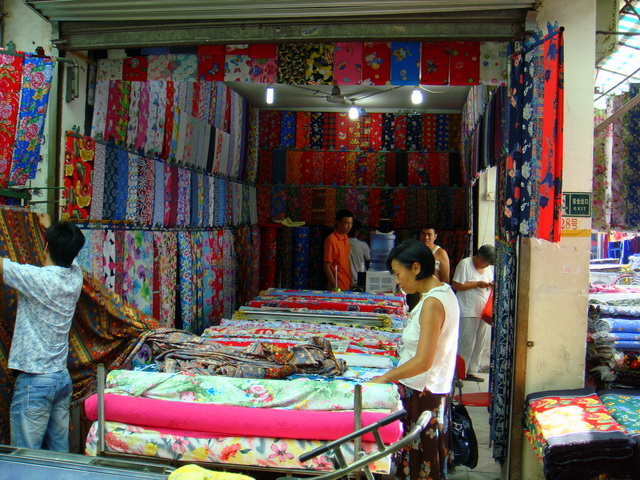
Have you noticed most of our children’s clothes are designed by ChinaSprout? How? Let me show you! First, I visit the market to select the fabrics.

Then I meet with our tailor, and together we design the dresses or jackets. We’ve made many samples but select only a few to offer our customers. See the fabric I selected this time?

Here are the dresses . How do you like them?


Antique Market
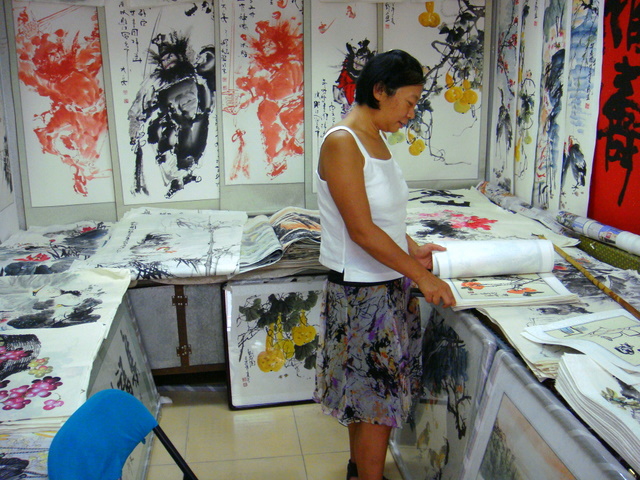
It is called Antique Market, but most products there are not antiques. I buy many craft items there. You see our ink and brush vendor and painting vendors? Find anything that we sell?

I saw these cute clay figures, but I’m not sure if we will carry them. What do you think?

Anyway, I shopped all these markets in about two-thirds of a day. I’ll show you more shopping spree photos in my next posting. Now that you’ve seen these photos and learned that I shop ‘til I drop, would you want to shop with me in Beijing?

Wednesday, April 02, 2008

How did I start ChinaSprout?

You might be surprised at how little I learned about traditional Chinese culture while growing up in Beijing. I grew up during the Cultural Revolution in a not-tradition-focused family in Beijing. We didn’t celebrate many traditional festivals except for Chinese New Year and Moon Festival. I was not forced to memorize Tang poems or the time line of Chinese ancient history. I never used Nin (您) (you) to talk to my parents as most Beijing residents do. But after leaving China more than 20 years ago, I became fascinated with Chinese culture and love to share it with Westerners.

I founded ChinaSprout in June 1999. The idea for my company came from experiences I had during outings with my son, Simon, around Park Slope in Brooklyn, where I met many American families who have adopted children from China. I often found myself approached by these families wishing to know more about Chinese culture. I was impressed and moved by their enthusiasm and really wanted to help. I realized that most of these families had one thing in common: an incredibly strong desire to carry on their children’s cultural heritage. Although many of them didn’t have access to authentic Chinese or educational products, most of them spent time online looking for these things During that time, I became very interested in the Internet and e-commerce while studying for my MBA at Baruch College. I realized that I had found a niche market that had not been penetrated online. The logical next step was to create an online store to reach these families and to help them learn the Chinese language and culture. Thus, ChinaSprout was born.

While I am proud of what I’ve achieved, I also appreciate all the support and feedback from our customers, the hard work of my colleagues, and understanding and support of my family! So please let me know how we can improve our product line and services to make ChinaSprout an even better destination for you to learn about China, Chinese culture and Chinese language.

Monday, March 31, 2008

Introduction of ChinaSprout’s Blogs

I’ve been thinking about writing a blog for a long time, and finally now I have the chance to do it with our new website. In this blog, I’ll focus on Chinese culture, Chinese language education, and education in general. I believe these topics are of high interest to our audience and customers. I’ll also talk about how I started ChinaSprout, my life in China (more than 20 years ago), and childrens’ lives in contemporary China, since so many people ask me about that. I may also write about my buying trips in China, Taiwan, and Hong Kong, as well as trade shows I attend across the country. I will also share my experiences with Chinese language education – a topic I deeply care about and am actively involved with as a mother, Chinese woman, and vendor.

I’ll also invite my editors, colleagues, and experts in various fields to write about related topics. We plan to include book reviews (not only the books we carry), author interviews, home-schooling, Chinese language, Chinese arts, and more. We will announce these blogs as soon as they are available on our new site.

Our blogs will also link the news and information about China, Chinese culture and Chinese language education. We’ll allow readers to post comments and will post them after reviews. I do hope readers will share their information, experiences, and expertise about China and especially Chinese language education.

If you have suggestions, please let me know!

Xiaoning